The transition from physical “wet-ink” signatures to cryptographic digital signatures represents one of the most significant shifts in the history of commercial and legal documentation. As global commerce becomes increasingly decentralized and paperless, the requirement for robust mechanisms that ensure document authenticity, integrity, and non-repudiation has moved from a technical preference to a mandatory operational imperative. The economic stakes are profound; research suggests that Fortune 500 companies collectively lose an average of $12 billion annually due to inefficiencies caused by unstructured or manual document management.Furthermore, the
Here is an analysis of the structural barriers to adoption, the diverse regulatory landscapes across thirty major economies and the technical standards that define modern digital trust, concluding with the urgent requirements for transitioning to post-quantum cryptography.
The analysis can be broken down into two types of digital signatures:
Signatures created by endusers (esignature or digital signature)
Signatures created by organization (eSeals)
Strategic Resistance: Analyzing the Socio-Technical Barriers to Digital Signature Adoption for EndUsers
The persistence of traditional signing methods despite clear economic advantages points to a complex array of resistance factors that are psychological, organizational, and technological. The “social presence” of a signature is a primary psychological barrier; research indicates that documents signed by hand are perceived to carry more social weight and intent than those signed electronically. This perceived lack of authenticity contributes to high decline rates in digital signing workflows, with up to 30% of users refusing to sign digitally due to forgery concerns or a lack of trust in the platform’s validity.
Technologically, the “compliance mirage” often stalls adoption. Many software providers claim their solutions are “legal,” yet they fail to meet the specific regulatory requirements of high-stakes industries, such as HIPAA for healthcare, 21 CFR Part 11 for life sciences, or PCI DSS for finance.
When a generic solution fails to provide a robust, real-time audit trail or insufficient identity verification, it becomes a “ticking legal time bomb” for the enterprise. This technical complexity is compounded by the “Technical Trap” of slow, poorly documented, or unscalable APIs, which can turn a planned three-week integration project into a six-month operational bottleneck.
Core Barriers to Digital Signature Adoption
Barrier Category
Primary Factors
Strategic Impact
Cultural & Social
Tradition of manuscript signatures; perceived lack of social presence.
Reduces trust in cross-border deals and high-value contracts.
Technological
Complexity of setup; clunky APIs; poor mobile compatibility.
Project delays
Regulatory & Legal
Lack of uniformity across jurisdictions; fear of court inadmissibility
Businesses worry about potential fraud/breach.
Financial & Economic
High cost of entry for SMEs; per-envelope pricing; add-on fees for verification.
Deters small businesses still relying on paper.
Operational & UX
Mandatory sign-ups for receivers; complex interfaces.
Leads users to revert to “printing and scanning”.
The environmental context also plays a significant role. Factors such as the size of the adopting company, internal IT capability, and external pressure from competitors or regulators influence the adoption rate. In many cases, the “Human Element” is the final breaking point; if the software does not invoke feelings of “Trust and Ease,” employees and external signers will abandon the process, rendering the digital investment useless.
Friction Reduction Strategies for Digital Transformation
Achieving broad adoption requires more than just meeting legal requirements; it requires a deliberate strategy to reduce friction for both internal employees and external signatories.
The Three-Pillar Adoption Framework
Organizations should focus on a structured framework to ensure successful digital signature rollout:
Pillar of Simplicity: Ensuring the signing process is intuitive. Complex signing workflows where users must download, sign, and re-upload are a major deterrent. Furthermore, mobile optimization is critical, as many declines occur due to poor smartphone compatibility. Businesses that educate their users on the legal acceptance of e-signatures report 20-25% fewer declines.
Pillar of Zero Friction: Eliminating barriers for external parties. Signatories should never have to pay to sign a document or undergo mandatory registration processes unless strictly required for high-assurance levels.
Pillar of Trust: Clearly communicating security and compliance. Displaying certifications like ISO 27001 or SOCII and offering localized language support helps build global comfort.
Challanges in adopting Digital Signatures of internal document protection
While the barriers for individuals often focus on “personal touch” and psychological trust, businesses facing the challenge of protecting millions of in-house documents through electronic seals (eSeals) encounter a different set of structural and technical obstacles.
Here are the top 5 reasons businesses are not opting for digital signatures/eSeals for long-term document integrity:
1. The “Technical Trap” of Legacy Integration
Enterprise-level document integrity requires that eSeals be applied automatically and in bulk within existing corporate systems (CRMs, ERPs, or ECMs). However, many organizations rely on legacy infrastructures that are not compatible with modern signing APIs. A complex integration that is expected to take weeks can turn into a “six-month nightmare,” draining IT resources and creating operational bottlenecks.
2. The Maintenance Burden of Long-Term Validation (LTV)
Ensuring document integrity for 10, 20, or 50 years is not a one-time event; it is a lifecycle management problem.
Certificate Expiration: Digital certificates have limited lifespans. Without proactive Long-Term Validation (LTV) – which involves embedding full certificate chains and revocation status (OCSP/CRL) at the time of signing a perfectly valid signature can become unverifiable once the certificate expires.
Algorithm Obsolescence: As cryptographic standards evolve, signatures created today may become weak in 10 years. This is also true when the timestamp signing cert get expired. This requires “archival level” signatures (like PAdES B-LTA) that necessitate periodic re-timestamping with stronger algorithms to maintain legal and technical validity. Many businesses lack the internal PKI expertise to manage this ongoing preservation.
3. The “Quantum Stability” Paradox
As shown in the Comparison Table (Classical vs. PQC) (see below), existing asymmetric foundations like RSA and ECDSA are now labeled as “becoming obsolete under quantum threat” because they are breakable by Shor’s algorithm. Organizations are often hesitant to invest heavily in sealing millions of archived documents using classical methods that they know will require a massive, complex migration to Post-Quantum Cryptography (PQC) in the near future. This creates a “wait and see” attitude that leaves current archives unprotected.
4. Poor Regulation Implementation
In some developing countries, rules for long-term document retention exist on paper but enforcement and practical auditing of integrity controls are weak or inconsistent. That creates two corrosive effects: organizations skip implementing cryptographic integrity measures (like digital signatures / eSeals) because auditors rarely check for them, and a cultural perception grows that “if no one else is doing it, why should we?” The result is a chronic under-investment in document integrity until a legal or operational incident forces a reaction — often too late.
5. Data Storage and “Size Penalty” Overhead
For businesses managing “astounding” volumes of documents such as the manufacturing industry or banks handling petabytes of data storage efficiency is a primary concern.
Overhead Costs: As highlighted in the comparison table, PQC signatures (like ML-DSA) have a significantly larger footprint than classical ones (~3 KB vs. ~72 bytes).
Archival Impact: When applying a seal to billions of files, the “size penalty” of post-quantum-ready signatures or the inclusion of bulky LTV metadata adds up to massive increases in storage and bandwidth costs, which can deter high-volume adoption.
5. High Costs and “Minimum Usability” of Qualified Solutions
In many jurisdictions (such as the EU under eIDAS), only Qualified Electronic Seals provide a legal presumption of integrity and origin. However, these “Qualified” solutions are the most expensive and complex to implement:
Infrastructure Costs: They require Hardware Security Modules (HSMs) to protect signing keys and ongoing fees to Qualified Trust Service Providers (QTSPs).
Administrative Friction: Compliance leaders cite a “time crunch” and lack of expertise in navigating the stringent technical requirements of these high-assurance models, leading many to revert to simple, non-cryptographic internal approvals that offer far less integrity protection.
Vertical-Specific Requirements: A Sectoral Analysis of Digital Integrity
Different industry verticals have evolved unique requirements for document management, driven by their specific regulatory burdens and the nature of the data they handle. Healthcare, finance, and legal services generate the highest volumes of critical documentation, requiring specialized digital signature applications that can withstand rigorous audits.
Healthcare and Clinical Documentation
Information is the lifeblood of the healthcare industry, where patient records, insurance claims, and diagnostic reports must be accessed instantly, particularly in emergency scenarios. The primary mandate in the United States is HIPAA, which requires that records of any action, activity, or assessment be retained for a minimum of six years from the date of creation or from the date when a policy was last in effect.
Financial Services and Securities
Financial institutions handle petabytes of sensitive data annually. The regulatory landscape here is dominated by the Securities and Exchange Commission (SEC) and the Financial Industry Regulatory Authority (FINRA). Specifically, SEC Rule 17a-4 and FINRA Rule 4511 require the preservation of books and records for at least six years, with a strict requirement that they be stored in an accurate, complete, and easily accessible format.
The technical burden on financial firms is to protect the integrity of these records from the moment of creation throughout the entire retention period. This often necessitates “Write Once, Read Many” (WORM) storage or electronic recordkeeping systems (ERS) that maintain a complete time-stamped audit trail of all modifications and deletions. Failure to comply can result in massive fines, as seen in recent years when the SEC issued fines to numerous firms for failing to preserve “off-channel” electronic communications.
Manufacturing, Legal, and Real Estate Verticals
The manufacturing and construction industries generate extensive paper trails, including blueprints, safety certifications, and supply chain logs. Here, digital signatures are vital for operational efficiency, as they allow project managers to pull up information at a moment’s notice to meet tight deadlines.
In the legal sector, digital signatures must ensure that documents are typeset clearly and remain unalterable, which is essential for handling sensitive information securely and ensuring that documents are court-admissible.
Real estate transactions involve a high degree of complexity due to the need for cross-referencing listings, pending sales, and pending acquisitions. Professionals in this field rely on digital systems to guide clients to properties more efficiently, though they must navigate specific exclusions, such as wills and property transfers, which in some jurisdictions still require wet-ink signatures or physical notarization.
Industry Vertical Comparison of Document Management Metrics
Comparative Technical Standards: PAdES, XAdES, CAdES, ASiC, and JAdES
The choice of a digital signature format is not merely a technical preference but a strategic decision that impacts document security, long-term integrity, and cross-platform compatibility. The European Telecommunications Standards Institute (ETSI) has defined several standards for Advanced Electronic Signatures (AdES) to cater to different data types and use cases.
PAdES: The PDF-Centric Standard
PAdES (PDF Advanced Electronic Signature) is specifically designed for PDF documents and is integrated directly into the file structure. This ensures that the signed document remains readable with any standard PDF viewer while maintaining full legal value. Its primary advantage is its support for visible signatures and long-term validation (LTV).
Technical levels of PAdES include:
B-T (Baseline-Timestamp): Includes a trusted timestamp to prove existence at a certain time.
B-LT (Baseline-Long Term): Embeds certificate chains and revocation status (OCSP/CRL), ensuring the signature is verifiable even after the certificate expires.
B-LTA (Baseline-Archive): Adds archive timestamps to protect against algorithm obsolescence over decades.
XAdES: XML Advanced Electronic Signatures
XAdES is the standard for signing XML data. It is highly versatile, supporting “detached” signatures where the signature and the data it protects are stored separately. This is ideal for automated B2B workflows, e-invoicing, and structured data exchanges between systems. XAdES is both human-readable and machine-readable, making it suitable for regulatory reporting and supply chain management.
CAdES, JAdES, and ASiC: Specialized Formats
CAdES (CMS Advanced Electronic Signature) is based on the Cryptographic Message Syntax and is file-agnostic, meaning it can sign any binary data (images, spreadsheets, videos). However, it typically wraps the original file in a .p7m container, requiring specialized software to open and validate.
JAdES (JSON Advanced Electronic Signature) is designed for JSON formats, providing a way to sign JSON data structures in web services and RESTful APIs.
ASiC (Associated Signature Container) provides a standardized way to package one or more data objects with their signatures and validation metadata into a single container, such as a ZIP file.
Signature Standards Feature Comparison
Feature
PAdES
XAdES
CAdES
JAdES
Target Format
PDF documents.
XML documents.
Any binary file.
JSON structures.
Visibility
Supported (Graphic).
Render-dependent.
Not supported.
Not supported.
Validation
Standard PDF readers.
XML parsers.
Specialized software.
JSON parsers.
Storage
Embedded in file.
Enveloped or Detached.
.p7m cryptographic envelope.
Detached or Enveloped.
Archival
LTA level (Archive).
Extensible for long-term.
Extensible for long-term.
Extensible for long-term.
Global Regulatory Landscape: A Survey of 30 Major Economies
The legal validity of digital signatures is contingent upon compliance with local regulations, which differ significantly across jurisdictions. There are two primary approaches to electronic signature legislation: the minimalist (or permissive) model and the prescriptive (or restrictive/tiered) model.
Categorization of Legal Models
Minimalist (Permissive): Technology-neutral laws that allow e-signatures to be enforceable in virtually every case, with few exceptions. Examples include the United States, Canada, Australia, and the UK.
Prescriptive (Tiered): Laws that distinguish between different levels of signatures (Simple, Advanced, and Qualified). Qualified Electronic Signatures (QES) often carry the same legal weight as handwritten signatures. This model is used by the European Union (eIDAS) and many Asian economies.
Digital Signature Laws in Top 30 GDP Economies (2025 Update)
Requires certification from government-approved trusted providers.
Germany
eIDAS, Trust Services Act (VDG)
Perspective
Strong focus on Qualified Electronic Signatures (QES) for high-risk deals.
Japan
Act on Electronic Signatures
Perspective
Regulated signatures via accredited Certification Authorities hold more weight.
India
Information Technology Act, 2000
Prescriptive
Only signatures using DSC from licensed Certifying Authorities are binding.
United Kingdom
Electronic Communications Act 2000
Minimalist
Uses UK eIDAS post-Brexit; recognizes typed names and scanned images.
France
Civil Code (Arts 1366, 1367)
Perspective
Presumes validity if it identifies the signer and ensures integrity.
Italy
Digital Administration Code (CAD)
Perspective
Grants e-signatures the same value as handwritten ones if reliable.
Russia
Federal Law No. 63-FZ
Perspective
Hierarchical: Simple, Enhanced Unqualified, and Enhanced Qualified.
Canada
PIPEDA
Minimalist
Secure e-signatures required for certain federal legal documents.
Brazil
Provisional Measure 2.200-2/2001
Prescriptive
Hierarchical system (ICP-Brasil); updated recently for digital adoption.
Spain
Law 6/2020
Perspective
Regulates trust services; complements EU eIDAS regulation.
Mexico
Federal Commerce Code (2003)
Perspective
Accepts e-signatures as legally binding with few exclusions.
South Korea
Electronic Signature Act
Perspective
Moving toward national PQC algorithm suites (HAETAE, AlMar).
Australia
Electronic Transactions Act 1999
Minimalist
Validates e-signatures for most contracts; favors pure PQC by 2030.
Turkey
Electronic Signature Law No. 5070
Perspective
Secure electronic signatures have the same effect as wet-ink.
Indonesia
ITE Law
Prescriptive
Requires certification by domestic providers for legal recognition.
Netherlands
Electronic Signatures Act
Perspective
Non-qualified signatures valid if signing method is “sufficiently reliable”.
Saudi Arabia
Electronic Transactions Law
Prescriptive
Requires licensing of providers by the local regulator (CST).
Poland
eIDAS Regulation
Perspective
Significant growth in cloud-based DMS solutions.
Switzerland
ZertES
Perspective
High standards for qualified certificates; tax haven for financial data.
Taiwan
Electronic Signatures Act
Perspective
Tiered model; excludes certain family and property documents.
Belgium
eIDAS Regulation
Perspective
High-income economy with advanced digital infrastructure.
Ireland
Electronic Commerce Act 2000
Minimalist
High market for data centers and financial services.
Argentina
Law 25,506 (Updated 2024)
Perspective
Decree 743/2024 allows remote identity verification for certificates.
Sweden
eIDAS Regulation
Perspective
Leader in digital adoption and innovation.
Singapore
Electronic Transactions Act (ETA)
Minimalist
Integrated with Singpass national digital ID systems.
UAE
Federal Law No. 1 of 2006
Prescriptive
Advanced signatures required for government contracts; TDRA licensed.
Austria
Signature and Trust Services Act
Perspective
Fully aligned with eIDAS tiered model
The Transition to Post-Quantum Cryptography (PQC)
The most significant looming challenge for digital signatures is the threat posed by Cryptographically Relevant Quantum Computers (CRQCs). Existing asymmetric algorithms like RSA and ECDSA rely on mathematical problems – specifically integer factorization and discrete logarithms that quantum computers can solve efficiently using Shor’s algorithm.
Aspect
Classical Public-Key Cryptography
Post-Quantum Cryptography (PQC)
Mathematical Foundation
Based on integer factorization (RSA) and discrete logarithms (ECC, Diffie–Hellman).
Based on mathematical problems like lattices, hash chains, error-correcting codes, and multivariate equations.
Quantum Vulnerability
Breakable by Shor’s algorithm, which can solve factorization and discrete logs on large-scale quantum computers.
Specifically designed to resist both classical and quantum attacks (including Shor’s and Grover’s).
Hardware Requirements
Runs efficiently on standard classical computers.
Runs on standard classical computers—no quantum hardware is required for operation.
Security Assumption
Computational difficulty for classical systems; keys become vulnerable as quantum computing scales.
Hardness believed to hold against both classical and quantum attacks.
Data Size (Overhead)
Minimal and efficient (e.g., ECDSA signatures are typically around 72 bytes).
Significantly larger footprint; ML-DSA signatures are ~2-3 KB, while SLH-DSA can reach 17 KB.
Cryptographic Agility
Low; often hardcoded into legacy protocols, firmware, and application code.
High priority; systems must support the seamless replacement of algorithms as standards evolve.
Ubiquitous globally but currently being deprecated under NIST and NSA migration guidance.
NIST standards finalized (2024); phased enterprise and national security migration is underway.
The Impact on Signature Standards
In 2024, NIST standardized several PQC algorithms to replace legacy systems. ML-DSA (Module-Lattice-Based Digital Signature Algorithm), formerly known as CRYSTALS-Dilithium, has been selected as the primary standard for digital signatures. Unlike legacy systems, ML-DSA relies on the hardness of lattice-based problems, which are believed to be resistant to both classical and quantum attacks.
The primary challenge for document formats like PAdES, XAdES, and CAdES is the significant increase in signature size. An ECDSA signature is typically around 72 bytes, whereas an ML-DSA-65 signature is 3,309 bytes. This “size penalty” means that document containers must be able to accommodate larger cryptographic blocks, potentially impacting bandwidth and storage for high-volume users.
Aspect
Classical Public-Key Cryptography
Post-Quantum Cryptography (PQC)
Mathematical Foundation
Based on integer factorization (RSA) and discrete logarithms (ECC, Diffie–Hellman).
Based on mathematical problems like lattices, hash chains, error-correcting codes, and multivariate equations.
Quantum Vulnerability
Breakable by Shor’s algorithm, which can solve factorization and discrete logs on large-scale quantum computers.
Specifically designed to resist both classical and quantum attacks (including Shor’s and Grover’s).
Hardware Requirements
Runs efficiently on standard classical computers.
Runs on standard classical computers—no quantum hardware is required for operation.
Security Assumption
Computational difficulty for classical systems; keys become vulnerable as quantum computing scales.
Hardness believed to hold against both classical and quantum attacks.
Data Size (Overhead)
Minimal and efficient (e.g., ECDSA signatures are typically around 72 bytes).
Significantly larger footprint; ML-DSA signatures are ~2-3 KB, while SLH-DSA can reach 17 KB.
Cryptographic Agility
Low; often hardcoded into legacy protocols, firmware, and application code.
High priority; systems must support the seamless replacement of algorithms as standards evolve.
Ubiquitous globally but currently being deprecated under NIST and NSA migration guidance.
NIST standards finalized (2024); phased enterprise and national security migration is underway.
PQC Migration Timelines and Hybrid Strategies
Governments worldwide are setting ambitious deadlines for PQC migration, with a target completion year of 2035. The National Security Agency (NSA) requires national security systems to adopt NIST-approved PQC by 2027.
Region/Organization
Deadline/Goal
Hybrid Cryptography Policy
Recommended Algorithms
United States (NSA)
2027 (NSS) / 2035 (Total)
Allowed for transition only.
ML-KEM, ML-DSA.
European Union
2030 (High-risk cases)
Recommended during migration.
ML-KEM, ML-DSA.
Australia (ASD)
2030 (Pure PQC)
Not recommended.
ML-KEM, ML-DSA.
UK (NCSC)
Phased Migration
Interim measure only.
ML-KEM, ML-DSA.
Germany (BSI)
Long-term strategy
Recommended with caution.
ML-KEM, ML-DSA, FrodoKEM.
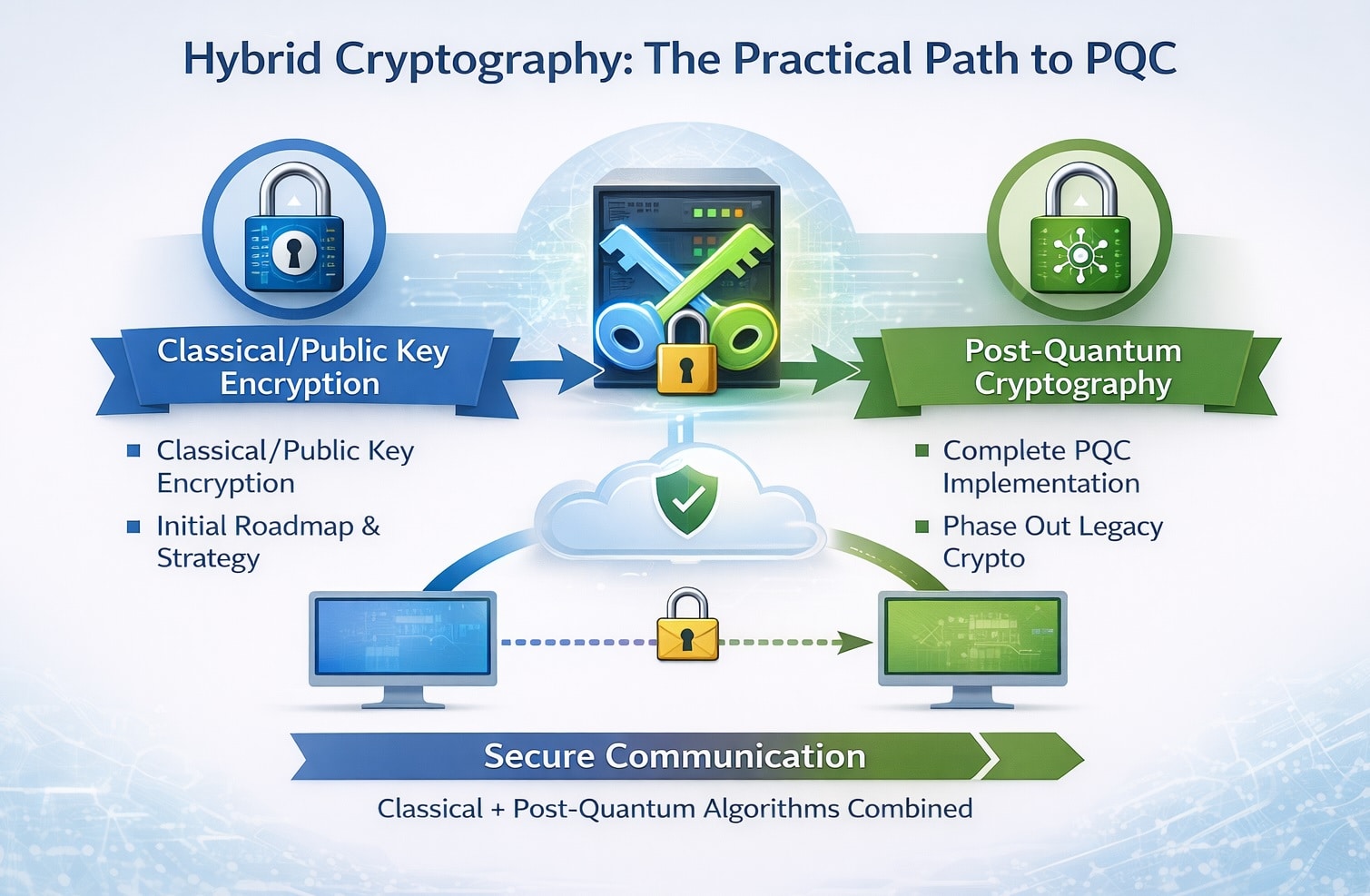
A hybrid approach combining a classical algorithm like ECDSA with a PQC algorithm like ML-DSA is widely recommended during the transition. This provides a “safety net,” ensuring security against current classical attacks while hedging against potential unforeseen weaknesses in the first generation of PQC algorithms.
Research and Implementation Strategic Framework
To fulfill the requirements for a comprehensive research plan, organizations must adopt a phased approach to auditing their current cryptographic landscape and planning for a future-proof digital signature infrastructure.
Phase 1: Discovery and Vulnerability Diagnosis
The baseline for any digital signature strategy is a comprehensive cryptographic inventory. Organizations must identify where and how digital signatures are currently used across TLS, VPNs, PKI, and third-party APIs. Automated discovery tools should be used to detect hardcoded or legacy algorithms hidden in compiled code or firmware.45
Phase 2: Prioritization and Risk Assessment
Not all data requires the same level of protection. Systems should be prioritized based on both data lifespan and exposure surface. Long-lived data such as medical records, intellectual property, and government archives must be protected first, as they are vulnerable to “harvest now, decrypt later” attacks or tampering.
Phase 3: Infrastructure Modernization (The Khatim Roadmap)
Deploying a centralized signing server like Khatim allows for the “abstraction of security layers”. This enables organizations to achieve cryptographic agility, where algorithms can be replaced or updated without redesigning entire business systems.
Strategic steps include:
Integrating existing HSMs for root key protection.
Setting up multiple signing policies for different document types (PAdES for contracts, XAdES for invoices).
Pilot-testing hybrid PQC implementations in non-production environments to benchmark latency and certificate performance.
Phase 4: Compliance and Vendor Coordination
Quantum readiness is an ecosystem-wide challenge. Organizations must coordinate with cloud providers, software vendors, and hardware manufacturers to ensure consistent algorithm support. Furthermore, they must ensure that their chosen platforms comply with the evolving regulatory frameworks of the jurisdictions in which they operate, such as eIDAS 2.0 in Europe or updated land registry rules in Latin America.
The transition to Post-Quantum Cryptography (PQC) represents a fundamental shift for the primary digital signature formats (PAdES, CAdES, XAdES, JAdES, ASiC) and their underlying Cryptographic Message Syntax (CMS). The standardization landscape is currently in a state of high activity, with ETSI and IETF leading efforts to integrate quantum-resistant algorithms into these established frameworks.
Current Standardization Status and Evolving Frameworks
The European Telecommunications Standards Institute (ETSI) and the Internet Engineering Task Force (IETF) are the primary bodies defining how NIST-standardized PQC algorithms, such as ML-DSA (Module-Lattice-Based Digital Signature Algorithm), will be integrated into signature containers.
ETSI TS 119 312: This technical specification, which defines recommended cryptographic suites for all ETSI Advanced Electronic Signature (AdES) formats, is currently being updated to include QSC (Quantum-Safe Cryptography) algorithms. Because PAdES and CAdES are designed to be algorithm-agnostic, they can technically support PQC algorithms once these are officially cataloged in TS 119 312.
IETF LAMPS (CMS and S/MIME): The IETF’s LAMPS working group is actively drafting standards for using ML-KEM and ML-DSA within the Cryptographic Message Syntax (CMS), which serves as the foundation for CAdES and PAdES. This includes draft-ietf-lamps-cms-kyber for key encapsulation and efforts surrounding “composite signatures” that combine classical and PQC algorithms for the transition phase.
ETSI TS 103 744 (Hybrid Key Establishment): Published in early 2025/2026, this specification provides a roadmap for “quantum-safe hybrid key establishment,” combining classical ECDH with ML-KEM to ensure confidentiality during the migration.
Technical Challenges and Impact per Format
The primary hurdle for all these formats is the “size penalty.” PQC signatures and keys are significantly larger than their classical counterparts, requiring updates to the internal structures of document containers.
Base for CAdES; requires new OIDs and logic for larger ML-DSA signatures.
PAdES
PDF / ISO 32000
PDF readers must be updated to handle larger signature blocks (~3KB for ML-DSA vs ~72B for ECDSA).
CAdES
CMS-based
Must accommodate larger cryptographic envelopes, potentially increasing the size of.p7m files.
XAdES
XML-based
XML’s extensible nature makes it easier to add PQC attributes, but canonicalization and processing overhead may increase.
JAdES
JSON-based
New standard under development; being built with crypto-agility in mind for RESTful PQC web services.
ASiC
Containers (ZIP)
Packaging larger certificates and revocation data for long-term validation (LTV) increases container size.
Evolution of Standards for PQC Support
While the core NIST algorithms (ML-KEM, ML-DSA, and SLH-DSA) were finalized in 2024, the “application-level” standards are still evolving. Organizations like ETSI are providing “Repeatable Frameworks for Quantum-Safe Migrations” (ETSI TR 104 016) to guide stakeholders through this shift.
Support for “extended” signature profiles (like PAdES B-LTA) will be critical, as these archive-level signatures are designed to withstand algorithm obsolescence through periodic re-timestamping with stronger, quantum-resistant algorithms. Current enterprise solutions are already beginning to support “Cryptographic Agility,” allowing protocols to be updated via policy rather than code rewrites as these standards reach final versions in 2026 and beyond.
Enterprise Solution Profile: Khatim Sign Server & KhatimDoc
Khatim Sign Server is an enterprise-grade utility designed to simplify the “last mile” of digitization by providing a robust, PKI-driven signing solution. It allows organizations to achieve document authenticity, integrity, and non-repudiation while ensuring documents remain verifiable for years into the future.
Technical Architecture and Security
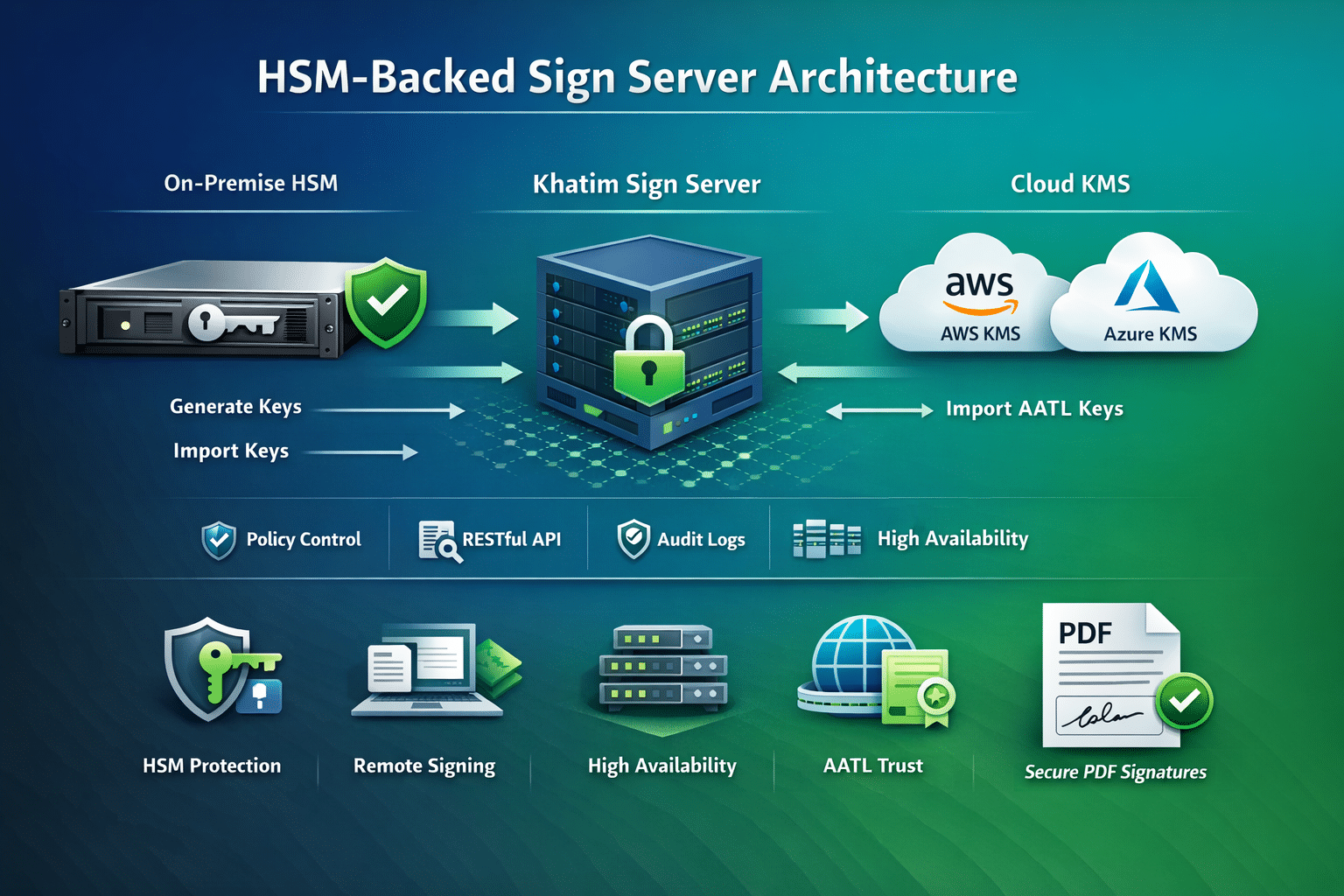
Built from the ground up for scalability and resilience, Khatim Sign Server integrates with existing corporate systems such as CRMs, ECMs, and ERPs. It supports all major IETF and ETSI standards, including PAdES, XAdES, CAdES, JAdES, and ASiC. A critical feature for high-trust environments is its ability to integrate with Hardware Security Modules (HSMs) or Smart Cards via PKCS#11, ensuring that signing keys are never exposed in software.
Key enterprise features include:
Cryptographic Agility: Supports classical RSA and ECDSA as well as Post-Quantum Cryptography (PQC) like ML-DSA (Dilithium). For more details see Post-Quantum-Ready Signing (CMS & PKCS#1).
Military-Grade Access Control: Uses AES 256 encryption and TLS client authentication for administrative access.
Detailed Auditing: Records all incoming transactions and configuration data, including lower-level cryptographic objects like CRLs, OCSP responses, and timestamps. For more details, see Detailed Logging & Auditing for Digital Signatures.
High Performance: Can be installed as a cluster of multiple signing servers to reduce latency and provide unparalleled throughput for high-volume environments. For more details, see HSM-Backed Sign Server Architecture.
The Signing Workflow
The processing logic within the Khatim environment is designed for speed and reliability. The business application sends a signing request via developer-friendly RESTful APIs. The signing engine verifies the request, creates the digital signature, adds a trusted timestamp if required and embeds revocation information for long-term validation. This centralized approach allows enterprises to enforce consistent signing policies across diverse business applications.
KhatimDoc: Accelerating Contract Lifecycle and Collaboration
KhatimDoc provides an advanced digital signature platform designed to revolutionize the contract signing process by ensuring security, authenticity, and regulatory compliance. It serves as a strategic enabler of digital transformation by digitizing manual workflows, which reduces paper expenses and accelerates signature completion. Engineered for global collaboration, KhatimDoc allows stakeholders to sign documents from any device across different time zones, maintaining business momentum while adhering to international standards such as eIDAS, ESIGN, HIPAA, and FDA 21 CFR Part 11.
Key features driving digital transformation include:
Enhanced Productivity Tools: Includes pre-configured templates and a central document gallery to eliminate re-uploads of common files.
Security and Tracking: Offers document access PINs, time limits, and real-time tracking to monitor package states and specific reasons for declined signatures. For more details, see Secure & Adobe Compatible Digital Signatures.
Enterprise Integration: Provides JSON-based RESTful APIs for seamless connection with ERP, ECM, and CRM systems, while supporting white-label branding and self-managed deployment for total data sovereignty. For more details, click Enterprise Ready Digital Signature Software
Nuanced Outlook: The Future of Digital Integrity
The synthesis of this analysis suggests that:
Digital signatures are no longer a static technological feature but a dynamic component of global cybersecurity infrastructure.
The economic waste associated with paper-based systems is becoming an unacceptable operational risk
The path to full digitization is fraught with cultural and technical hurdles.
The emergence of post-quantum threats complicates this landscape further, requiring a level of “cryptographic agility” that few organizations currently possess.
The successful organization of 2030 will be one that has moved beyond the “compliance mirage” to implement a zero-friction, PKI-driven signing architecture.
Centralizing signature management & prioritizing user experience can ensure that their digital commitments remain trustworthy, verifiable, and legally binding across the global economy.
The cost of inaction is high: every trade secret and private conversation remains at risk of exposure unless a deliberate, quantum-safe transition begins now.
"Securing Digital Trust in a Quantum Future"
Explore each section to understand the impact of quantum computing on cryptography and how to transition securely, incrementally, and without disruption.
To provide the best experiences, we use technologies like cookies to store and/or access device information. Consenting to these technologies will allow us to process data such as browsing behavior or unique IDs on this site. Not consenting or withdrawing consent, may adversely affect certain features and functions.
Functional
Always active
The technical storage or access is strictly necessary for the legitimate purpose of enabling the use of a specific service explicitly requested by the subscriber or user, or for the sole purpose of carrying out the transmission of a communication over an electronic communications network.
Preferences
The technical storage or access is necessary for the legitimate purpose of storing preferences that are not requested by the subscriber or user.
Statistics
The technical storage or access that is used exclusively for statistical purposes.The technical storage or access that is used exclusively for anonymous statistical purposes. Without a subpoena, voluntary compliance on the part of your Internet Service Provider, or additional records from a third party, information stored or retrieved for this purpose alone cannot usually be used to identify you.
Marketing
The technical storage or access is required to create user profiles to send advertising, or to track the user on a website or across several websites for similar marketing purposes.


 Key features driving digital transformation include: