Move from a Fragmented PQC Transition to Continuous PQC Governance
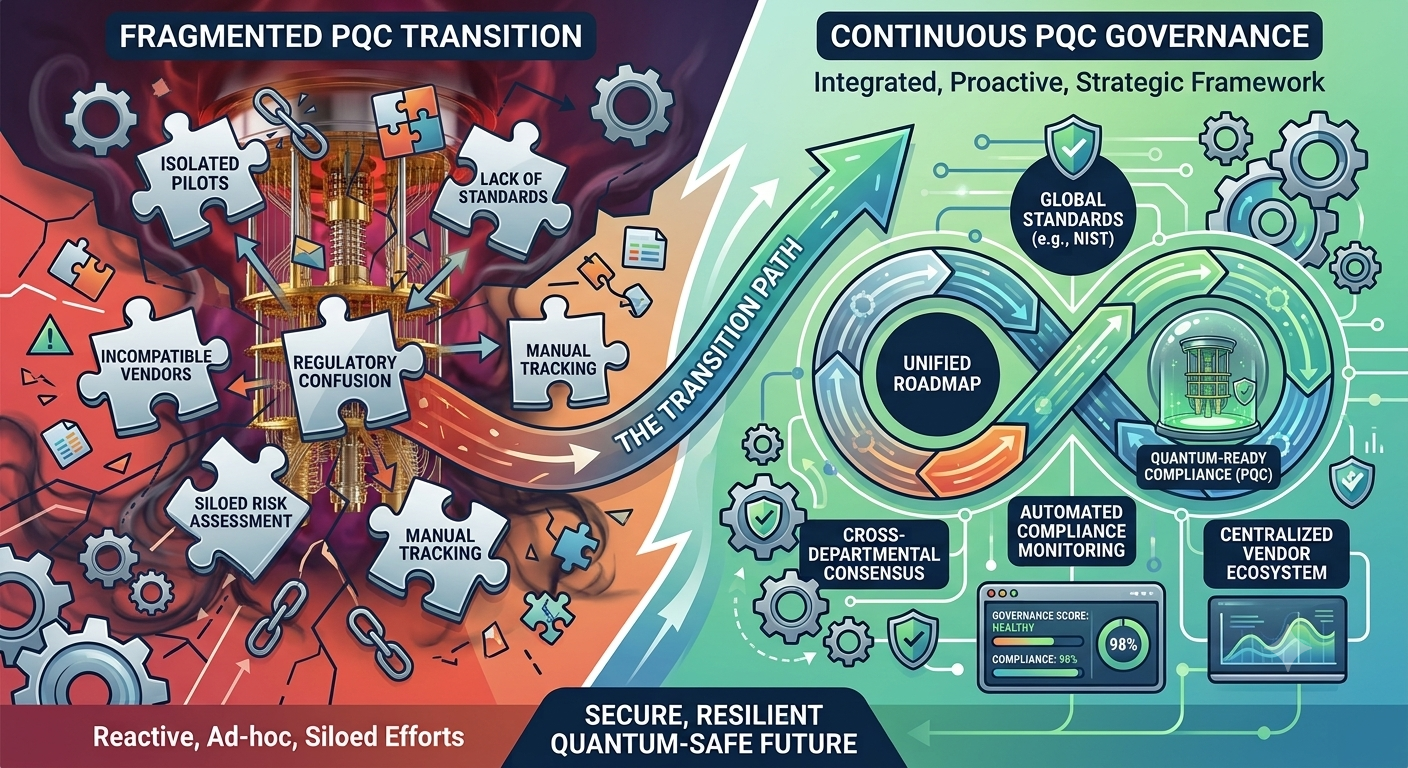
Executing a Post-Quantum Cryptography (PQC) transition is not just a highly technical upgrade. It is a massive organizational logistics challenge. Many PQC migration initiatives stall because tracking remediation across distinct hardware, software, and cloud environments quickly becomes unmanageable when relying on standard spreadsheets.
PQC Manage acts as the dedicated enterprise alternative to manual spreadsheet-based PQC tracking.
Why Enterprises Need Centralized Post-Quantum Cryptography Governance


Enterprise-Wide PQC Health
Gauge your exact quantum readiness posture across the entire corporate footprint. PQC Manage aggregates local and international data streams, allowing you to instantly benchmark, visualize, and analyze PQC health variations between separate global regions and business units.

Task Accountability
Say goodbye to unassigned risk. By pairing granular infrastructure assets directly with local technical owners and regional remediation leads, engineering branches gain immediate clarity on ownership, dramatically cutting down project bottlenecks.

Unified CBOM Visibility & Cryptographic Posture
Map your complete cryptographic posture under a single pane of glass. Ingest complex Cryptographic Bills of Materials (CBOM) and natively correlate algorithms, key lengths, and cryptographic dependencies directly to their production environments.

Verifiable History
Build an unalterable, chronological timeline of your quantum compliance. The system logs every technical test plan, verification deployment, and regional executive sign-off, replacing manual validation with clean, audit-ready data.
PQC Manage Usages
Migration Governance
Establish a single pane of glass for migration leaders and CISOs. Define overall program scopes, track multi-team task velocity, and monitor project burn-down rates directly against enterprise transition target dates.
Crypto Inventory
Maintain a living ledger of your corporate crypto footprint. Consolidate and monitor cloud workloads, software libraries, physical or virtual hardware nodes, and third-party dependencies to ensure zero security blindspots.
Compliance & Auditing
Gather evidence along the entire remediation journey. Require engineers to submit proof of work at every phase, building a strict, historical audit trail of what was migrated, when & by whom for undisputed compliance reporting.

PQC Migration Management Features
Features you get from PQC Manage
-
CXO Dashboards
Communicate risk and readiness clearly to the boardroom. Dedicated high-level executive dashboards compile multi-team data into a unified PQC Health score, charting milestone progress, budgeting burn-down, and compliance deadlines without technical noise. The platform dynamically isolates or aggregates data so you can accurately evaluate PQC health across multiple geographic regions or individual subsidiaries.

-

PQC Transition Planning and Risk Mitigation
Establish your enterprise foundation. Define your migration scope, identify and onboard PQC heads, form cross-functional remediation teams, and allocate high-level budgets directly within the platform to drive early organizational accountability.
-

Comprehensive Asset Management
Bring structure to your hybrid infrastructure footprint. Import your existing assets list as a CSV & build a unified ledger of your organization’s assets—including cloud environments, commercial packages, internal software and physical hardware. Assets can be assigned to specific team members across any department, enabling the company to distribute remediation workloads and execute the PQC migration at a much faster pace. With the support of bulk operations, simplify your asset management & PQC transition.
-
Asset PQC Transition
Drive engineering accountability through structured milestones. Technical owners can map out, schedule, and document precise execution paths for R&D, Testing, Production Deployment, and Final Validation across every system under their care.
-
Cryptographic Bill of Materials (CBOM) Management & Mapping
Achieve true cryptographic transparency. Easily import, organize, and manage Cryptographic Bills of Materials (CBOM) against your assets. Directly link underlying cryptographic libraries, active key lengths, and target algorithms straight to your asset ledger.
-
Military Grade Access Control
Trusted personnel can only access PQC Manage functions via powerful, password less authentication using military-grade TLS Client authentication.


Deployment
-
Supported OS
All flavors of Windows Server.
-
Languages
5 Languages (English, Chinese, French, Spanish, Croatia etc.)
-
Minimum H/W Requirement
8 GB RAM, 2 vCPU (2.3 GHz), 10 GB disk space.
Words from Client
Leading companies rely on us for their PKI and digital signature needs
We were struggling with our PKI implementation when Codegic came to the rescue. They not only sorted our technical issues but also designed the whole PKI for the infrastructure.
Hemal Patel, CEO, Ray Pte. Ltd.
Pricing
- PQC Manage is charged per bundle
- Each bundle allows you to deploy 2 instance of PQC Manage in high availability mode
- To add more servers in your existing pool; Add more bundles OR Buy a single server instance at 50% of the bundle price
- Test environments or Staging environments are charged 50% of the price
Maintenance Plan
With active annual software maintenance plan:
- Keep your installation safe and secure with the latest security updates
- Get free access to the newest features, enhancements, and bug fixes
- Get premium support from our technical engineers (within 24 hours on business days)
Has your maintenance expired?
Want to renew your maintenance plan? The price for 12 months is 25% of your license’s (current) list price.
Save more with extended supported
- Extend for 24 months and save 10%
- Extend for 36 months and save 15% best value
FAQs
How do global enterprises track post-quantum cryptography readiness across multiple subsidiaries and regions?
Yes. Managing a decentralized PQC transition requires isolated metrics for local infrastructure alongside global aggregation. PQC Manage allows global enterprises to group assets by region, operational branch, or subsidiary. This allows corporate leaders to view a comprehensive, high-level PQC Health score for the entire organization, while regional security managers gain full visibility to focus specifically on their local infrastructure transitions.
What is the difference between automated cryptographic discovery and PQC migration governance software?
Cryptographic discovery scanners map your active network footprint, whereas PQC governance software manages the actual multi-year human and technical remediation workflows. PQC Manage is a pure management, governance, and workflow orchestration platform. It does not perform network scanning; instead, it is designed to cleanly ingest your asset inventories and Cryptographic Bill of Materials (CBOM) data (via file imports or manual setup). For deep automated network and machine discovery, teams use a dedicated discovery tool like PKI Insights.
How do teams use this application on a day-to-day basis?
PQC leads use it to maintain budget control and monitor high-level remediation deadlines. Technical team members use it to view their assigned assets, log their specific R&D or deployment test plans, and upload evidence or “proofs of work” once an asset has successfully transitioned to a PQC algorithm.
What kinds of assets can be managed within the system?
You can manage any enterprise asset that utilizes cryptography. This includes physical or virtual hardware, cloud environments, custom internal software, commercial off-the-shelf software and firmware.
Why shouldn't we just track this migration in a standard spreadsheet?
A PQC migration is a continuous governance cycle involving dozens of cross-functional stakeholders over multiple years, making static tracking tools highly insecure and prone to stagnation. Spreadsheets fail because they lack multi-user workflow assignment, real-time burn-down analytics, historical audit logs, and built-in tracking for testing or validation milestones. Furthermore, spreadsheets cannot cleanly link complex, nested Cryptographic Bill of Materials (CBOM) structures directly to an operational asset ledger, creating critical operational blind spots.