In modern, hyper-distributed enterprise environments, you cannot secure what you do not know exists. While establishing robust monitoring for known internal and external endpoints is a critical operational baseline, the greatest security and operational risks often stem from unmanaged, untracked, or “shadow” certificates.
"You cannot secure what you cannot see."
The Hidden Risks of Rogue and Shadow Certificates
Many organizations suffer from the illusion of complete certificate visibility. Network environments are dynamic, and without automated guardrails, the delta between “inventoried certificates” and “deployed certificates” grows daily.
-
Unexpected Operational Outages: A single expired certificate on a non-standard port can halt critical backend services or internal API communication, disrupting business continuity despite your primary web endpoints showing a clean bill of health.
-
Expanded Attack Surface: Shadow certificates often rely on deprecated cryptographic standards, weak key sizes, or legacy hashing algorithms (such as SHA-1). Malicious actors actively scan networks for these weak links to orchestrate man-in-the-middle (MitM) attacks or compromise internal traffic.
-
Compliance and Audit Failures: Regulatory frameworks like PCI DSS 4.0, NIS2, and DORA demand strict data protection and asset accountability. Failing to maintain an accurate, exhaustive inventory of all cryptographic assets across your enterprise can result in severe compliance penalties.
"An unmanaged certificate is an outage waiting to happen and a vulnerability waiting to be exploited."
Network-Wide Automated Discovery: How PKI Insights Uncovers the Unknown
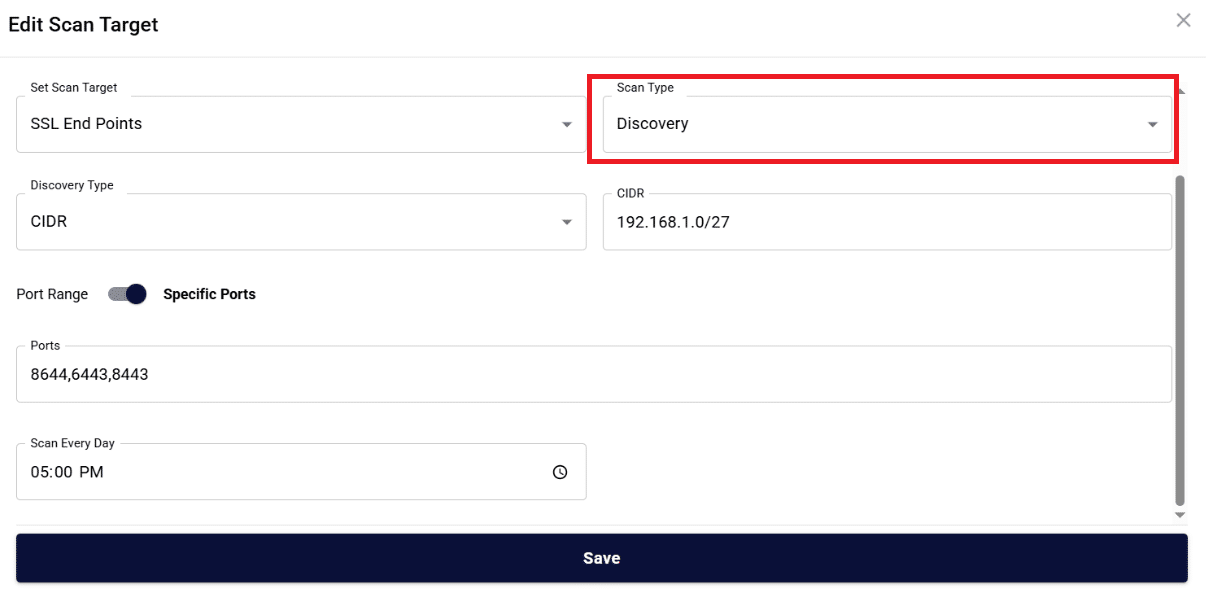
To eliminate manual spreadsheets and rogue credentials, PKI Insights features a robust, network-wide Certificate Discovery engine. Instead of relying on manual reporting, administrators can define precise scanning parameters to systematically map out their digital landscape.
Flexible Network Mapping
Admins can configure scans utilizing highly flexible network targeting definitions:
-
IP and CIDR Boundaries: Scan specific host IPs or broad subnets (e.g.,
10.0.0.0/24) to sweep entire data centers or cloud environments. -
Advanced Port Targeting: Target standard and non-standard services concurrently. Ports can be defined using comma-separated values for specific endpoints (e.g.,
443, 8443, 9443) or ranges (e.g.,443-450) to uncover hidden services bound to obscure ports.
Continuous Background Execution
Network landscapes evolve constantly, making one-time snapshots obsolete. PKI Insights runs its discovery engine as a continuous background process. Admins configure a designated execution time (e.g., daily at 02:00 AM) to ensure the scan runs seamlessly during low-traffic windows without manual intervention.
From Discovery to Actionable Operational Intelligence
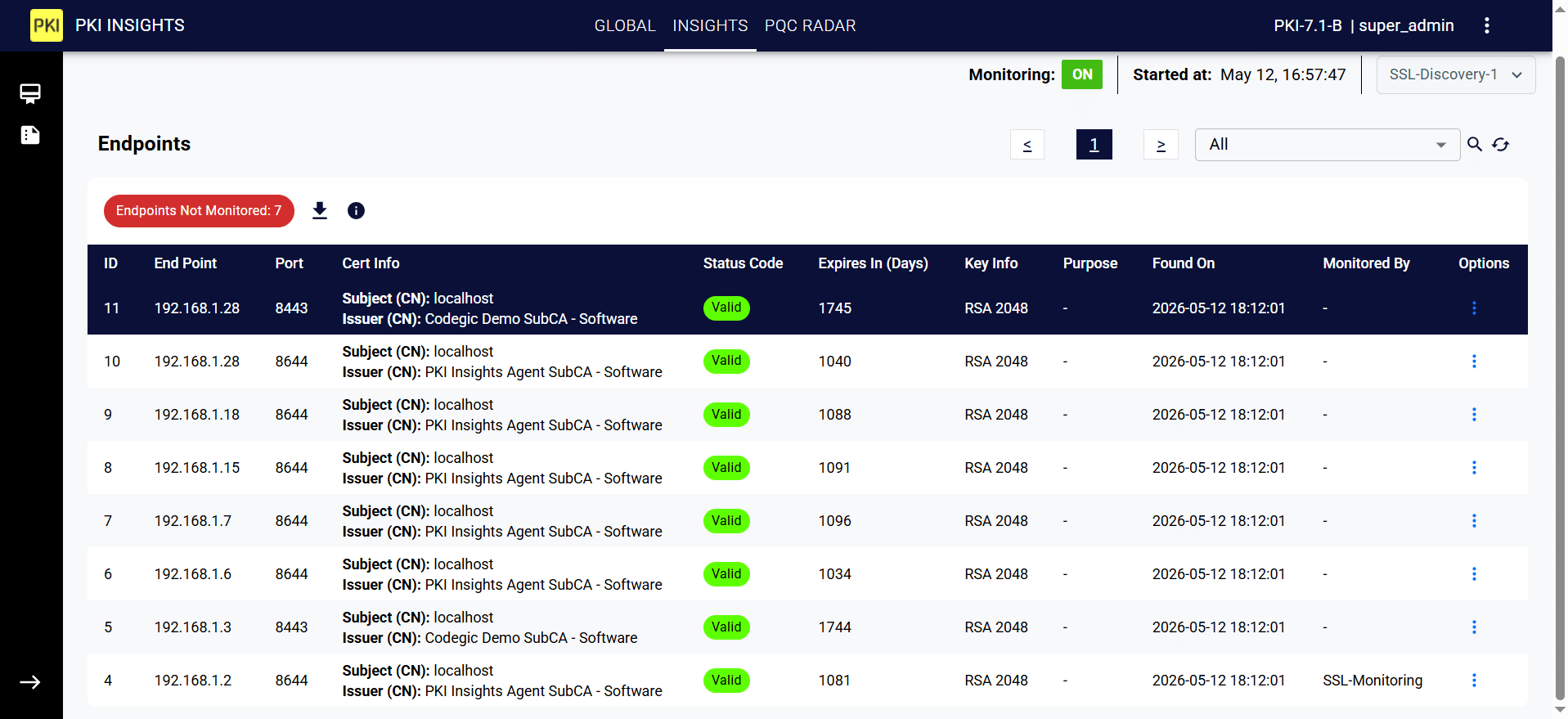
Once a discovery job completes, the background engine aggregates the raw data and transforms it into structured, actionable intelligence within the administrator’s dashboard.
For every certificate uncovered, the platform provides context-rich details, including:
-
Deployment Context: The precise IP address, hostname, and port where the certificate was discovered.
-
Cryptographic Parameters: Detailed certificate telemetry, including Subject Alternative Names (SANs), issuing Certificate Authority (CA), expiration date, key length, and signature algorithm.
This centralized view immediately separates known, monitored certificates from unmanaged assets, allowing infrastructure teams to pinpoint exactly where rogue credentials reside and prioritize remediation based on expiration proximity or algorithm risk.
Bridging the Gap: Exporting and Onboarding Unmonitored Certificates
Discovery is only half the battle; closing the visibility loop requires seamless onboarding into your proactive health monitoring workflows. PKI Insights bridges this gap with intuitive data management pipelines.
If the discovery engine identifies active certificates that are not currently under active surveillance, the administrator can seamlessly filter for these unmonitored assets. With a few clicks, this data can be exported.
These exported records can then be imported directly into the respective TLS/SSL scanners within the platform. This workflow transitions newly found assets from “discovered shadow certificates” to “actively monitored endpoints”—ensuring they are tracked for expiration, protocol vulnerabilities, and post-quantum readiness moving forward.