"Post-Quantum Cryptography does not change why we use PKI. It changes how trust is established, signed, exchanged, and validated"
PQC Lab
Evaluate & explore ML-DSA–based certificate issuance, signing and verification in a non-production environment.
What Stays the Same, What Changes
What Stays the Same
-
X.509 certificate model
-
Trust chains (Root → Intermediate → End-entity)
-
Certificate lifecycle (issuance, renewal, revocation)
-
PKI governance and policies
What Changes
-
Cryptographic algorithms
-
Key and signature sizes
-
Certificate sizes
-
Performance characteristics
-
Infrastructure assumptions
"PQC does not replace PKI - it replaces the cryptography inside PKI"
Algorithm Mapping: Classical vs PQC
Key Exchange
|
Purpose |
Classical PKI |
PQC-Enabled PKI |
|---|---|---|
|
Secure key exchange |
RSA, DH, ECDH |
ML-KEM (Kyber) |
|
Security basis |
Factoring / discrete log |
Lattice-based problems |
Digital Signatures
|
Purpose |
Classical PKI |
PQC-Enabled PKI |
|---|---|---|
|
Certificate signing |
RSA, ECDSA |
ML-DSA (Dilithium) |
|
Stateless signatures |
ECDSA |
SLH-DSA (SPHINCS+) |
"NIST-selected PQC algorithms are designed for standardization and large-scale deployment, not academic elegance"
Key, Signature & Certificate Size Comparison
PQC introduces larger cryptographic artifacts.
Indicative Sizes (Approximate)
|
Item |
Classical |
PQC |
|---|---|---|
|
Public key |
64–256 bytes |
1–2 KB |
|
Signature |
64–512 bytes |
1–3 KB |
|
End-entity certificate |
~1 KB |
3–6 KB |
|
Certificate chain |
Small |
Significantly larger |
"Larger keys and certificates impact networks, devices, and validation services"
Performance & Operational Impact
Computational Impact
-
PQC algorithms often:
-
Have faster key generation: Some PQC signature schemes (e.g., hash-based SPHINCS+, or certain code-based schemes) can have heavy operations and slower key gen. In short, PQC performance is algorithm dependent.
- Require more memory: Post-quantum cryptographic algorithms typically require more memory than classical RSA/ECC schemes because their key and signature/ciphertext sizes are significantly larger. For example, NIST-standardized PQC keys and signatures are measured in kilobytes versus tens or hundreds of bytes for RSA and ECC, increasing memory footprint and data movement overhead in constrained systems.
-
Have larger data movement costs: PQC’s larger key and ciphertext/signature sizes lead to higher data movement costs during protocol execution and storage compared to classical cryptography. Protocols and systems must handle increased packet sizes and RAM usage, which can impact throughput, cache behavior, and network load
-
Network Impact
-
Larger TLS handshakes
-
Bigger OCSP responses
-
Larger CRLs
-
Increased latency on constrained networks
Storage Impact
-
Certificate databases grow faster
-
Logs and archives increase in size
-
Embedded storage constraints become relevant
Impact on PKI Components
Certificate Authorities (CAs)
-
Larger signing operations
-
Longer certificate issuance pipelines
-
Increased HSM interaction complexity
Validation Services
-
OCSP and CRLs grow in size
-
Timestamp tokens become larger
-
Long-term validation artifacts expand
Relying Parties
-
Applications must support new algorithms
-
Certificate parsing and validation logic must evolve
"PQC is not “slower” everywhere - but it is different everywhere"
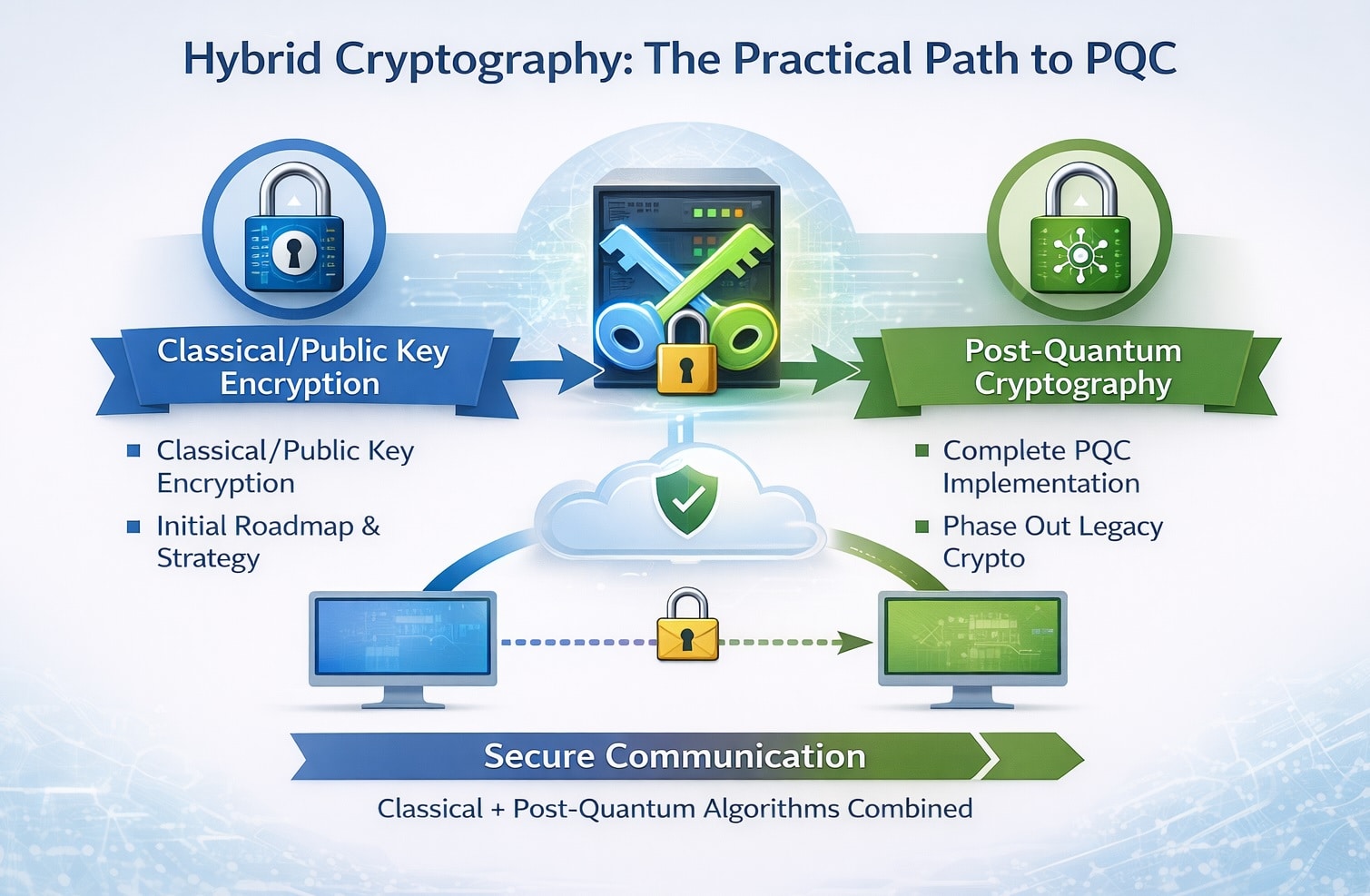
Hybrid PKI: Classical + PQC Together
Most real-world deployments will not switch overnight.
Hybrid Approaches Include:
-
Dual signatures (classical + PQC)
-
Hybrid key exchange in TLS
-
Parallel certificate chains
Benefits:
-
Backward compatibility
-
Defense-in-depth
-
Gradual ecosystem transition
Trade-offs:
-
Larger certificates
-
More complex validation
-
Increased operational overhead
"Hybrid PKI is not a compromise - it is a strategy."
Why PQC-PKI Is Not a Simple Upgrade
PQC affects assumptions that were previously “free”:
-
Network MTUs
-
HSM throughput
-
Certificate parsing limits
-
Embedded firmware constraints
Ignoring these leads to:
-
Failed deployments
-
Performance regressions
-
Incompatibility issues
"PQC readiness is an engineering problem, not a checkbox"
What This Comparison Tells Us
-
PQC-enabled PKI is inevitable
-
Classical PKI assumptions no longer hold
-
Size, performance, and compatibility must be engineered
-
Transition planning matters more than algorithm choice
FAQ
What fundamentally changes in PKI when moving from classical to post-quantum cryptography?
The core PKI trust model remains the same, but the cryptographic primitives change. Classical PKI relies on RSA and ECC for key exchange and digital signatures, which are vulnerable to quantum attacks. Post-Quantum PKI replaces or augments these with quantum-resistant algorithms such as ML-KEM and ML-DSA. This shift affects key sizes, certificate structures, validation performance, storage requirements, and interoperability across PKI components.
How does certificate lifecycle management change with PQC?
Certificate lifecycle management becomes more critical with PQC. Larger keys and signatures increase processing costs, making long-lived certificates less desirable. Organizations are expected to shorten certificate lifetimes, automate issuance and renewal, and improve visibility into certificate usage. PKI systems must support faster rotation, scalable revocation mechanisms, and automated monitoring to manage the increased operational load.
Does Post-Quantum PKI replace classical PKI immediately?
No. The industry is moving toward hybrid PKI, where classical and post-quantum algorithms are used together. Hybrid certificates or hybrid key exchanges ensure security even if one algorithm is later compromised. This approach provides backward compatibility, aligns with NIST and NSA guidance, and allows organizations to transition gradually without breaking existing trust relationships.
How do key and certificate sizes differ between classical PKI and PQC-based PKI?
Post-quantum algorithms use significantly larger public keys and signatures than RSA or ECC. For example, an ECC public key may be only a few dozen bytes, whereas a PQC public key or signature can be several kilobytes. This increases certificate sizes, TLS handshake payloads, OCSP responses, and log storage. PKI systems must therefore handle higher bandwidth usage, larger databases, and increased memory consumption.
What is the impact of PQC on TLS, code signing & document signing?
- In TLS, PQC primarily affects key exchange and authentication, increasing handshake sizes and potentially latency.
- For code signing and document signing, larger signatures affect storage, transmission, and verification times.
- Long-term validation (LTV) becomes more important, as documents and binaries must remain verifiable even after classical algorithms are deprecated.
- PKI architectures must adapt to ensure performance and compliance are maintained.
Can existing PKI infrastructure be reused for Post-Quantum PKI?
Partially. Core PKI concepts such as CAs, trust anchors, and certificate chains remain valid, but many components require upgrades. Cryptographic libraries, HSMs, CAs, and validation services must support PQC algorithms and hybrid modes. Systems that are crypto-agile can adapt more easily, while legacy or hard-coded environments may require replacement or significant redesign.
Why Post-Quantum Cryptography (PQC) Matters
Challenges in Adopting Post-Quantum Cryptography
Classical PKI vs Post-Quantum PKI

How to Prepare Your Organization for PQC
Hybrid Cryptography: The Practical Path to PQC